|
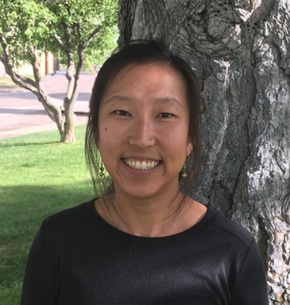
Dr. Ulrich is an Assistant Professor in the Ecology Department examining plant physiological responses to and interactions with their environments in forest, agricultural, and grassland ecosystems. Dr. Ulrich received her PhD from Oregon State University, applying a diverse suite of tools and approaches to understand plant physiological responses to environmental stress across multiple spatial and temporal scales in coffee, ponderosa pine, and Douglas-fir. As a Postdoctoral Fellow at the Los Alamos National Laboratory, she explored plant-microbe interactions and how soil microbes influence plant physiological responses to drought. In her spare time, you can find Dr. Ulrich mountain biking, telemark skiing, trail running with her dog, and learning to fly fish.
|
Background
Assistant Professor, Ecology Department, Montana State University, Bozeman, Montana 2019-Present
Chick Keller Postdoc Fellow, Bioscience Division, Los Alamos National Laboratory, Los Alamos, New Mexico 2017-2019
Oregon State University, NSF Graduate Research Fellow, Ph.D., Forest Ecosystems & Society, Corvallis, Oregon 2017
Oregon State University, M.S., Tree Physiology, Corvallis, Oregon 2013
Plant Pathology & Ecology Department, Connecticut Agricultural Experiment Station, New Haven, Connecticut 2010
Bowdoin College, A.B., Biology, Brunswick, Maine 2010
Assistant Professor, Ecology Department, Montana State University, Bozeman, Montana 2019-Present
Chick Keller Postdoc Fellow, Bioscience Division, Los Alamos National Laboratory, Los Alamos, New Mexico 2017-2019
Oregon State University, NSF Graduate Research Fellow, Ph.D., Forest Ecosystems & Society, Corvallis, Oregon 2017
Oregon State University, M.S., Tree Physiology, Corvallis, Oregon 2013
Plant Pathology & Ecology Department, Connecticut Agricultural Experiment Station, New Haven, Connecticut 2010
Bowdoin College, A.B., Biology, Brunswick, Maine 2010
|
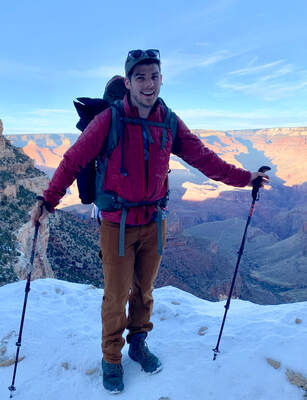
Sean Hoy-SkubikSean Hoy-Skubik is a graduate student at Montana State University where he is pursuing a PhD in Ecology & Environmental Sciences from the Department of Ecology. He attended Vassar College in Poughkeepsie, NY as an undergraduate, where he received a degree in Biology and spent two years working at the Vassar Farm and Ecological Preserve. After graduating he spent four years working for the USGS in Moab, UT, studying how climate change, mining activity, and livestock production affect ecosystem function on the Colorado Plateau. Sean is particularly interested in how organismal level adaptions affect ecosystem level processes, especially in the context of a changing climate. In his free time Sean enjoys mountain biking, skiing, snowboarding, paddle boarding, exploring with his dog, or simply relaxing with a good book.
|

|
Teo RautuTeo Rautu is attending Montana State University as a graduate student in the Department of Ecology where she is pursuing a M.S. in Biological Sciences in the Ecology department. She is researching how forest mortality affects watershed hydrology within the Greater Yellowstone Ecosystem. Before coming to Montana, Teo earned her B.S. in Environmental Science from the University of Washington in Seattle, WA. She has spent multiple field seasons working across the Sierras and Cascades on forest research crews and has worked as a forestry consultant for a small non-profit in western Washington. Teo is excited to expand her research to the Rocky Mountains Ecoregion and learn about using geospatial models to assess ecosystem changes. During her free time, Teo likes to hike along ridgetops, go birdwatching, play pickleball, and travel to new places.
|
|
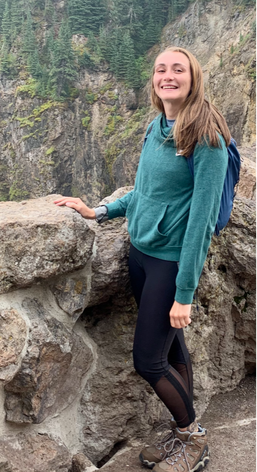
Jessica HarrisJessica Harris is a graduate student at Montana State University where she is pursuing a M.S. in Biological Sciences from the Department of Ecology. Jessica graduated from DePaul University in Chicago, IL with a BS in environmental science while running D1 cross country and track. During her undergraduate years, she conducted bryophyte research within the Botany Department at the Field Museum of Natural History and completed a soil lead gradient analysis within the Soil Science Lab at DePaul. After graduation, Jessica studied forest edge carbon dynamics in temperate forest ecosystems at ORNL in Oak Ridge, TN and later worked as a microbiology lab technician at Amway, Inc. Jessica is primarily interested in tree ecophysiology and plant-microbial interactions. She is currently studying how high-elevation pine species are responding to drought and heat stress with the goal to understand how forest composition will be impacted by climate change. In her free time, Jessica is an avid runner who also loves biking, hiking, volunteering at the animal shelter, and baking vegan treats for her friends.
|

|
Katie SparksKatherine Sparks is attending Montana State University to pursue a M.Sc. in Biological Sciences from the Department of Ecology. She received her undergraduate degree in Biology with a minor in mathematics from Missouri State University in Springfield, MO. Post-graduation, Katie completed two internship assignments with Oak Ridge National Lab where she studied larch and spruce responses to increased temperature and CO2¬, and worked with occupancy modeling for fish populations in the Tennessee River. She also interned with the US Forest Service surveying for threatened species and conducting invasive species management in the Monongahela National Forest. She is currently researching the responses of Foxtail pine to both abiotic and biotic stressors and is interested in the dynamics of secondary defense chemicals and non-structural carbohydrates. Outside of her academic life, Katie enjoys ice skating, hiking, baking, knitting, and anything creative.
|
|
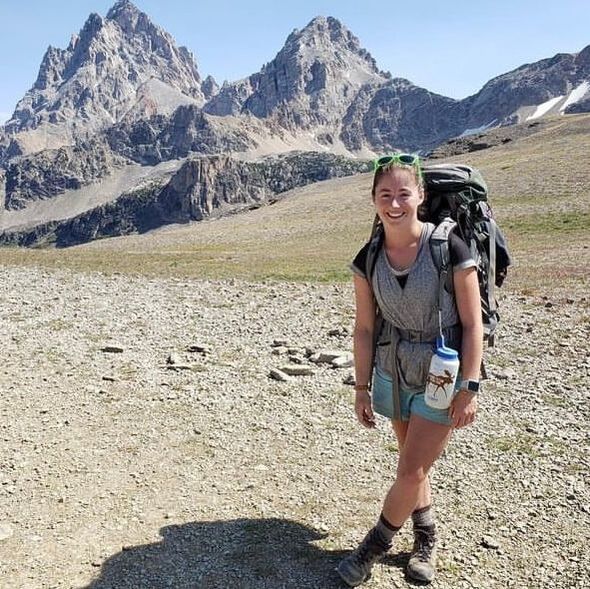
Lou DuloisyLou Duloisy is a graduate student at Montana State University where she is receiving her PhD in Ecology and Environmental Sciences. Her research focuses on investigating the physiological mechanisms and drivers of old-growth tree survival and mortality using tree-ring stable isotopes and dendrochronological approaches. Lou received her B.A. in Environmental Biology from Ohio University in Athens, OH in 2019 and her M.Ed. from Teton Science Schools and Antioch University in 2021. Her time working in environmental education, exploring the greater Yellowstone ecosystem, and working as a lab technician at Chapman University led to an interest in plant ecophysiology and pursuit of a graduate degree in Montana. When she's not studying or doing research, she loves to ski, bike, hike, and exploring new places.
|
|
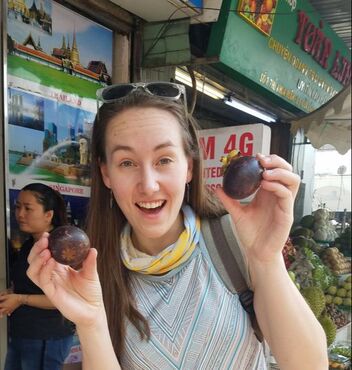
Hannah GoemannHannah (she/her/hers) is a Ph.D. candidate in the Microbiology and Cell Biology Dept. at MSU and got her BA in Biochemistry in her home state at the University of Minnesota Morris. Her thesis research focuses on using molecular biological techniques to understand the impacts of living biofertilizers on the soil microbiome and plant-microbe interactions under drought and heat stress. Outside of lab she enjoys running, Nordic skiing, and volunteering at the Gallatin Valley Food Bank. After graduation Hannah plans to seek a career in which she can combine her passions for soil science, food security, and sustainability.
|
Former lab members
Graduate
Chloe Wasteneys - MS, Physiological traits and stress tolerances of three high-elevation pine species
Franklin Alongi - MS, Drought limits terpene defense response to simulated herbivory while similarly reducing
non-structural carbohydrates in pine seedlings
Kelsey Flathers
Undergraduate
Sarah Kincy
Sam Bowne
Zoey Teale - NSF REU student
Tyler Boyd
Bobby Beers
Jaime Henriquez
Tristan Burlingame - Undergraduate Scholars Program awardee
Tim Jones - Undergraduate Scholars Program awardee
Naomi Vliet - Undergraduate Scholars Program awardee
Grace Miller - Undergraduate Scholars Program awardee
Benjamin Speirs
Jasmin Pflugmacher - visiting undergraduate from Gottingen, Germany
Jade Berghoff - Undergraduate Scholars Program awardee
Rachael Robbins - Undergraduate Scholars Program awardee
Jessie Irish
Meghan McFadden - visiting undergraduate from Whitman College
Jack Tierney
Chloe Wasteneys - MS, Physiological traits and stress tolerances of three high-elevation pine species
Franklin Alongi - MS, Drought limits terpene defense response to simulated herbivory while similarly reducing
non-structural carbohydrates in pine seedlings
Kelsey Flathers
Undergraduate
Sarah Kincy
Sam Bowne
Zoey Teale - NSF REU student
Tyler Boyd
Bobby Beers
Jaime Henriquez
Tristan Burlingame - Undergraduate Scholars Program awardee
Tim Jones - Undergraduate Scholars Program awardee
Naomi Vliet - Undergraduate Scholars Program awardee
Grace Miller - Undergraduate Scholars Program awardee
Benjamin Speirs
Jasmin Pflugmacher - visiting undergraduate from Gottingen, Germany
Jade Berghoff - Undergraduate Scholars Program awardee
Rachael Robbins - Undergraduate Scholars Program awardee
Jessie Irish
Meghan McFadden - visiting undergraduate from Whitman College
Jack Tierney
|
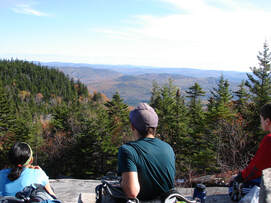
Your name here?We are always looking for new lab members so please contact Dr. Ulrich to discuss your interests and possible opportunities.
|
